
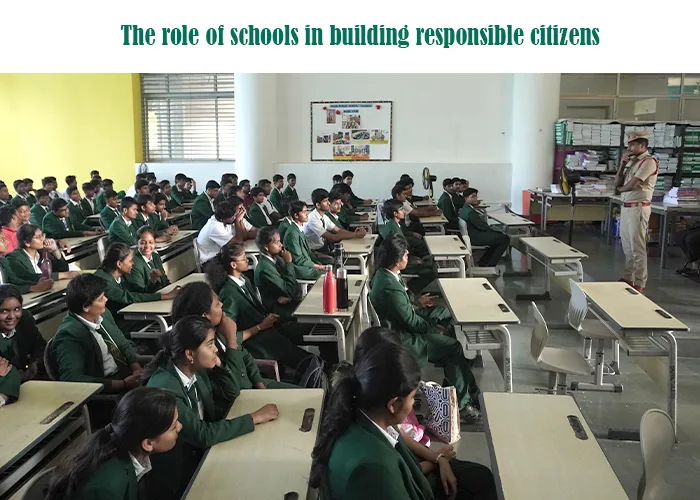
School is considered a place of learning, a place to shine in academics. But no it’s not that limited, school is also a place where our next generation is growing to become a responsible citizen who respects and is respected. A responsible citizen is someone who contributes to other people’s life by helping in some way which is guided by ethics and empathy. The role of school is dual: providing academic instruction while enhancing civic development of students. We at Delhi Public School (DPS) Warangal exemplify this dual role, we make our students become a model citizen and thrive beautifully.
Core elements of citizenship education in DPS Warangal
To educate about civic behavior, it takes time. It’s a holistic approach built on: curriculum that prioritises moral values, is democratic in practice, and includes experiential learning.
Value-based curriculum
Integrating values like ethics, integrity, and social responsibility into every lesson is crucial. Schools embed moral science and case studies of civic leaders and historical figures who championed social causes. For example, a science class explains technicality behind new technology, while a history lesson teaches students the qualities of a community leader in the past who ran an entire movement.
Democratic classroom practices
A classroom that teaches democracy must also practice it. This means students too take part in rule-making for their class, along with the teachers. Allowing students to have a say in classroom rules builds in them to take accountability. An open classroom climate where students can engage in debates and critical reflection on current events help them get aware about their sociopolitical surroundings, and it’s a great habit to have.
Experiential learning opportunities
Knowledge is useful when students truly practise it in situations. Our schools offer community service programs, students are told about different ecological topics that concern the country now. This way our students know what they should do, or should not to harm the environment by taking a step to sustainability. Student councils, mock elections, and Model UN simulations tell them the exact economic issues of the world, along with all other demographics. These opportunities transform abstract concepts of citizenship into tangible actions.
Above are the ways we implement the education and awareness of a good citizen which is bound to help them make good decisions as adults tomorrow- for the country, and as responsible citizens.
Instructional strategies that foster responsibility
Beyond a structured curriculum, certain teaching strategies are vital for cultivating the skills a responsible citizen needs.
1. Problem-solving and critical thinking
Engaging students in debates on current social issues helps them raise solutions keeping in mind different people’s perspectives and not being self centered at one. Project-based learning, where students come together to talk about local issues around school, like plastic waste reduction and steps to do it. Also, how they can contribute and participate, and bring change.
2. Empathy and collaboration
To be a responsible citizen, one must understand and connect with others. Role-playing scenarios and peer mentoring programs help students build emotional intelligence and see the world from different viewpoints. Group projects teach them how to co- work with others, manage conflicts, and value others’ contributions equal to their own.
3. Leadership and accountability
Schools can provide students with rotational leadership roles in clubs and teams, offering everyone a chance to practice leadership. Encouraging students to use reflection journals to evaluate their personal responsibility in their projects and daily interactions helps them build self-awareness and accountability.
DPS Warangal’s approach to building responsible citizens
Delhi Public School (DPS) Warangal stands out for the quality of our education, seamlessly working on building character of our students. We credit our students too for joining us in this venture and working as much as our teachers. Because the environment of our school is exactly so – calm, composed, full of curious minds who give off strong civic sense. The school’s mission goes beyond test scores – it’s way more than that.
1. Holistic character development programs
DPS Warangal at par with the CBSE curriculum with added emphasis on moral values – for us education isn’t fixed by a syllabus. It’s something that gives our students an outlook of being honest and helpful. Morals for us is not a separate subject but a living philosophy we follow. The school holds regular moral science workshops and assemblies that focus on talking about compassion, honesty, and justice, helping students understand the very basics of it.
2. Community engagement initiatives
The school actively encourages students to participate in helping the local community – who suffer due to any reason. It can be poverty or a faulty governance system. Through student-led community service projects, students learn about the challenges faced by people in the Warangal district and take ownership of finding solutions. DPS Warangal partners with many NGOs for environmental sustainability drives to teach students about their role in protecting the planet.
3. Leadership and global citizenship
DPS Warangal does not only make heads of the classrooms, we raise leaders who will step up to run a social system on international levels too. The school’s international exchange programs and cultural festivals promote global awareness and help students appreciate diverse perspectives. Participation in Model UN and student council provides for a realistic stimulation as how the global world runs and the position of their country. They become highly opinionated and educated about the real system of how the countries operate. This focus on global citizenship ensures students are ready to be responsible citizens in an interconnected world.
Practical strategies that DPS Warangal school follows
To build a new generation of responsible citizens DPS Warangal does these as a practise:
- Have an education system that includes morals and ethics: We teach and state examples of ethics, social studies, and moral science into all subjects.
- For the students, by the students: We welcome our student’s voice, we cherish it. They must do decision-making in the classroom and school governance.
- Offer our “responsible and moral” students “Head council” positions: When many students come together motivated to earn such a title – they all make very learning, responsible children and compete to become the most responsible.
- We engage our parents in the process as much as the school: Collaborate with parents and local organizations to create a unified support system for students’ civic development.
By including this study of civic behavior, we consider raising alumni who are known to be responsible, respected and helpful. It is our dear mission and our students become tomorrow’s leaders in any field they build themself. The approach taken by DPS Warangal serves as a powerful model for how academic rigor and character building can go hand-in-hand. We encourage the national curriculum to be overall proactive, ethical, so we come together and build such delightful members of society, ready to create a better future.