

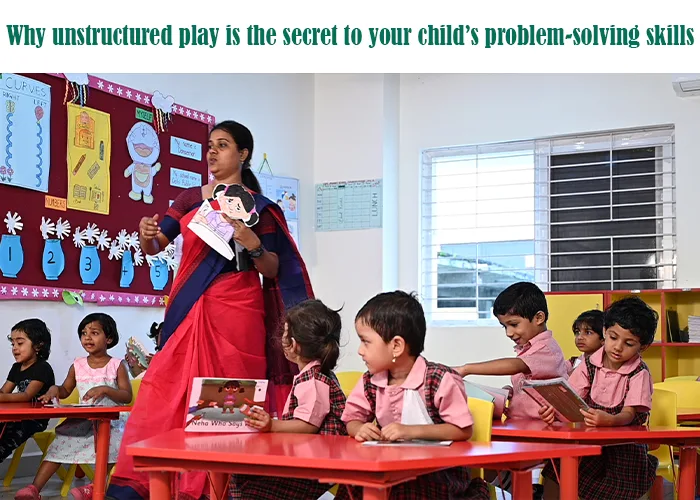
Adults are known to have a busy responsible life but children, too, look as packed as those of adults. But what about leisure time which is meant for playing and recharge? We at DPS Warangal aim to implant some new, healthy games that they can indulge in. Not only that, but they can also learn alongside. Unstructured play, also known as free play, is scientifically a fun way for children to learn. It gives them the freedom to explore, imagine, and create since there are no set rules to follow – the game’s a free flow. This type of play is not only about fun—it develops children’s problem-solving, decision-making, and social confidence.
What is unstructured play and why does it matter?
The difference between structured and unstructured play is easy to understand. Structured play has clear rules and involves adults who look out during the game, such as sports practice, music lessons, or playing a board game. These come with set rules for a participant to win. Unstructured play, on the other hand, is planned and played by children themselves. It is based on what they prefer at the moment, can be building a cushion fort, inventing a game in the backyard, or just lying down and daydreaming.
The benefits of unstructured play are many and wide-ranging. It encourages creativity and fuels imagination. It helps children become more resilient since the game is unstructured, it can go in any direction and children have to roll through it on spot. It develops motor skills as children run, jump, climb, and build. Most importantly, unstructured play gives children the chance to solve real-life problems by experimenting, making mistakes, and learning to self-regulate.
How unstructured play builds problem-solving skills
Unstructured play is the finest way to practise critical thinking. Whenever a child chooses to create a game on their own, they come across many cross directions which they figure and play and have fun. They do all of this on their own.
Examples include:
- Creating a game – Children have to decide on rules, set objectives, and handle disagreements. This makes them think carefully about how their choices affect others and the outcome.
- Resolving disputes – When two children want the same toy, they must talk, negotiate, and sometimes compromise to find a fair solution. These early experiences are powerful life lessons.
- Planning strategies – Activities like building a sandcastle that can withstand waves or stacking blocks into a tall tower require planning, problem-solving, and the ability to adapt when things don’t go as expected.
When they start playing the game, they come across even more puzzles. But children sail through and play, although the issues usually are not very critical. It adds when they do face something critical tomorrow, they will know how to chase the problem. Like – if a block tower falls, they try again. If a friend disagrees, they listen and pursue and then they all reach a common ground. They get used to the idea that failure is not a stop but to keep going till things make sense. These experiences form the foundation of a true problem-solver.
How DPS Warangal supports unstructured play
At DPS Warangal, we understand that play-based learning must be part of a child’s daily school life because only books can become boring. Also, a child can learn only in limits from a book, it is when they face something realistically, they may brace better. Hence below are the ways how we at DPS indulge in free play.
- Dedicated play spaces – We provide large open spaces, green gardens, and flexible play areas that children can turn into anything they imagine.
- Experiential learning – Alongside academics, we add play-based and hands-on learning activities that allow students to explore freely and learn at their own pace.
- Teachers as facilitators – Our teachers do not control play but instead observe and guide gently, asking questions that make students think deeper while celebrating their creativity and teamwork.
- Preparing future-ready learners – We see unstructured play as a way to build skills like critical thinking, adaptability, and collaboration. These are more valuable in the long run than rote memorization and prepare our students for the future.
Tips for parents to encourage unstructured play
Parents too can participate in unstructured play at home. Because while students learn something, they will also bond with their parents better. Such moments also bring parents and kids together on the values they share. By creating the right environment, you give your child the opportunity to grow in ways that will also put you in awe in the future.
- Provide a safe space – Give your child an area, indoors or outdoors, where they can play without worry or too many restrictions.
- Limit screen time – Too much screen time hampers a student’s credibility and imagination. They become dependent on it. Setting healthy limits will force them to use creativity for entertainment – which is great.
- Promote outdoor and imaginative play – Playing outside allows children to explore nature, run freely, and invent new scenarios. Even simple items like cardboard boxes or blankets can turn into exciting play props.
- Let them take the lead – Avoid directing every part of your child’s play. Let them choose what to do, how to do it, and whom to play with. Your role is to encourage and support, not to control.
The importance of play in child development cannot be overstated. Unstructured play is not just free time. It can be utilized in so many ways. To recharge, to learn, to rest and more. At DPS Warangal, our classroom promotes games as much as academics – all at par together for a student’s development. We also encourage parents to bring the same spirit into their homes, giving children the freedom to explore and grow. With guidance and independence together, children become confident problem-solvers in real life by taking small decisions in such games.