

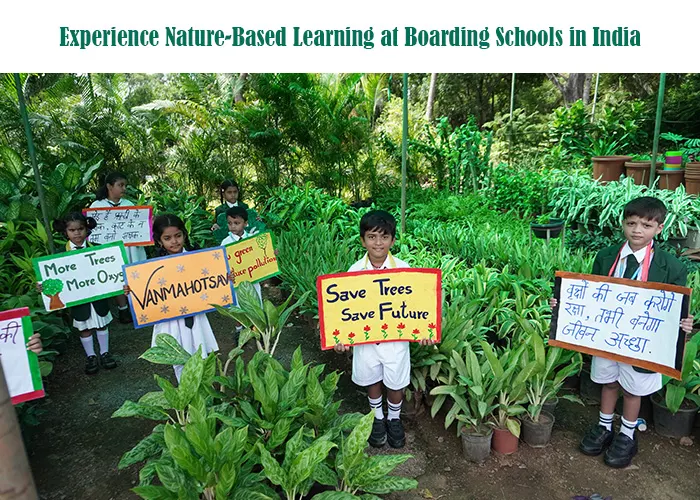
What if the best classroom for children in India isn’t within four walls, but under the open sky? This is the importance of nature-based learning (NBL). NBL is more than just learning outdoors; it utilizes nature as a powerful tool for teaching. Children learn through seeing, touching, and interacting with the real world around them.
In a country like India, with its many forests, rivers, hills, and open spaces, NBL is the perfect fusion. However, many schools continue to use rote learning.
DPS Warangal is showing how a boarding school can use NBL to facilitate more meaningful and balanced education for its children.
What is Nature-Based Learning?
Nature-based learning contains more than simply academic study outdoors, it is a way of linking experiences and lessons from the classroom to the environment. Instead of only using textbooks (or the students’ devices) and blackboards, students go outside and use nature as a classroom.
Nature-based learning involves all five senses, in which students experience learning by seeing, touching, hearing, smelling, and sometimes tasting, which makes learning fun and memorable.
- A biology course may include discussions on leaves and soil samples.
- Math concepts can be introduced by measuring tree shadows or counting stones.
- Weather systems become real, rather than just diagrams, when we see them ourselves.
This method provides quality assurance for students to not only memorize but also have understanding and retention of knowledge through meaningful, sensory experiences.
The Proven Benefits of Nature-Based Learning
Cognitive Growth
One of the most useful benefits of NBL is its influence on focus and creativity. Research shows that natural environments decrease distractions and improve children’s attention.
Students also become better problem solvers because they are encouraged to experiment, explore, and think creatively.
Physical and Emotional Well-being
Time spent in the outdoors reduces stress and anxiety. Green spaces can influence calmness and reduce negative emotions.
Nature-based lessons are also naturally involved in walking, digging, and planting, which helps boost physical health.
Social and Emotional Learning (SEL)
Outdoor projects such as shelters, gardening, or mapping trails give opportunities for students to practice teamwork, communication, and strength.
These projects also boost empathy and responsibility for the environment.
Early childhood provides an ideal window for nature-based education, as children at this stage are more open to exploration, observation, and experiential learning.
According to India Today, ideas like nature immersion, outdoor play, gardening, and composting are becoming a trend in early childhood education because they encourage curiosity, creativity, and sensory awareness.
Nature-Based Learning in Action at DPS Warangal
At DPS Warangal, nature-based learning is integrated into a structured curriculum, where students engage in hands-on projects, outdoor experiments, and sustainability initiatives that bring classroom concepts to life.
Spread on green grounds, the school combines its natural context as a resource to improve access to learning opportunities during daily education.
Science in Nature
Students learn about biodiversity through direct study, by composting, and by gardening in the environment.
Art in Nature
Students draw landscapes, collect materials from nature as part of a project, and generally let nature inspire their creative exploration.
Clubs and Activities
Nature photography, hiking groups, and organic gardening are types of activities that provide an opportunity for students to extend their exploration of personal skills and interests beyond the classroom.
Importantly, teachers learn to implement nature in their lessons instead of only including nature occasionally.
Even board curriculum requirements are creatively adapted. For example, EVS and biology projects are often done outdoors to bring theory to life.
The Boarding School Advantage
Boarding schools offer an ideal setting for nature-based education, as students live and learn in the same environment. Learning continues beyond the classroom. It becomes a seamless, all-day experience.
The daily living-learning environment could start with a relaxing walk in nature for the morning Community Experience. This morning ritual allows students to notice trees, various plants, birds, and breathe fresh air.
In the evening, students might be taken outside to observe the stars and sync up their science lessons on the stars with the real-world night sky.
On the weekends, students would be able to physically go out into different outdoor field sites to work on community projects; perhaps tending to the garden, hiking, or studying and observing local wildlife.
Ultimately, this 24/7 exposure provides greater opportunities and more potential for learning from nature than one can take from a day school. It makes learning from nature a normal routine!
Key Takeaway
Nature-based education gives education a sense of purpose. It improves concentration, reduces stress, creates confidence, and develops teamwork. Most importantly, it helps children become responsible and caring people.
DPS Warangal includes this practice in everyday living. With a large green campus, activity-based projects, and outdoor learning, the school prepares students not just for exams, but for life.
As stated by Mongabay India, exposure to nature-based programs significantly improves students’ understanding of climate change and environmental conservation. By adopting such experiential learning approaches, schools like DPS Warangal are building environmental literacy early on, assigning students to become informed, compassionate leaders capable of driving meaningful change.”
Because at the end of the day, the best classroom is maybe the world outside.