

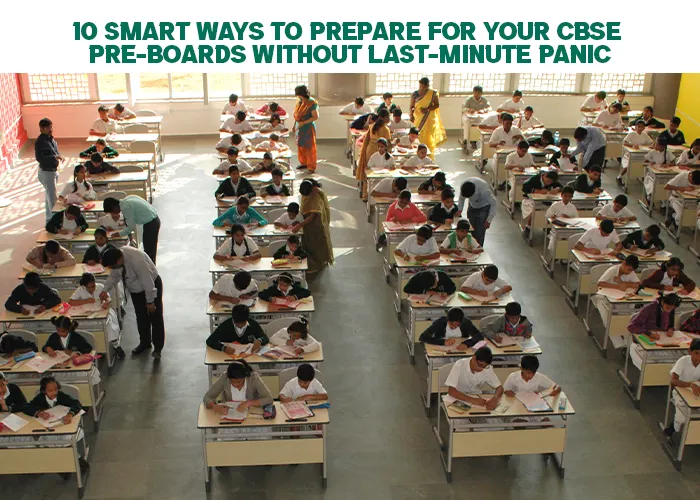
It’s that time of the year again. The CBSE pre-boards are around the corner and many students are feeling the pressure. The sleepless nights, endless revisions, and worrying about finishing the syllabus all lead to panic. But pre-boards are not meant to scare you.
They are meant to prepare you for the CBSE board exams and help understand where your strengths lie and where you need to work. Look at them like your practice match before the final game.
With a little bit of structure, discipline, and the right mindset, pre-board preparation can actually feel smooth and rewarding. Read the 10 smart ways to prepare for your CBSE pre-boards and turn your stress into calm and confidence.
Plan a realistic study timetable
Creating a good timetable is essential when preparing for your exams. It helps you remain sure about what you want to study to avoid wasting time. It brings a sense of order to your study sessions.
Prioritize your study days by subject distribution. Spend more time on challenging subjects or on chapters you find particularly difficult. Plan distinct times for review and practice tests. Don’t forget to include short breaks for your brain to recharge!
One effective method is the 2-hour study block technique with 15-minute breaks. This helps you maintain focus.
Avoiding last-minute rushes is possible with early planning, allowing you to effortlessly balance school and self-study.
Tip: A practical pre-board preparation schedule is one that you can accomplish every day without being stressed.
Prioritize high-weightage chapters for CBSE pre-boards
Some chapters carry more markings compared to other chapters in every subject for the CBSE pre-board exams. Look for those topics by consulting previous papers as well as sample question papers.
Initially, focus on the chapters with the highest weighting. When you have mastered those chapters, shift your focus on the moderate chapters and small chapters.
For example, in Science, the chapters on “Life Processes” and “Electricity” tend to carry more marks.
This approach provides an early sense of achievement and allows you to score more, even if you do not manage to complete the entire syllabus.
Tip: To help you with your tracking, note the important chapters on your syllabus sheet.
Practice with sample papers and mock tests
To ensure you feel confident on the day of your CBSE pre-boards, the most effective strategy is to practice as if it is the real exam situation, by attempting sample papers and mock tests each week.
Ideally, you should do one full-length mock test each week and replicate real exam conditions with the same timing, same format, and no distractions.
Once you finish the test, spend time evaluating your responses, figuring out where you lost marks, and where you made careless mistakes. Over time, steady practice will help you gain speed and will build your confidence. This is what champion academics do to get over nerves.
Tip: For the most recent mock papers, you could visit the CBSE website, as a reliable source.
Deepen concept clarity to excel in pre-boards
A lot of students memorize answers, but the CBSE pattern focuses on understanding. The more clearly you understand concepts, the more easily you can answer tricky questions, especially application-based ones.
Make NCERT books your primary study material. Read the examples, then summarize them in your own words. For best results, don’t hesitate to get help on complex concepts from your teachers or your study group. That said, there are support books that also focus and teach advanced topics. This guidance is available from your subject teacher; what difficulty level is appropriate for you should guide your study material further.
Alternate study techniques help retention. Try designing a mind map, practicing with questions, or teaching the material to an imaginary class.
Tip: As a rule of thumb, for both CBSE pre-boards and final exams, your best weapon is to have clear concepts.
Use smart revision strategies
Revision doesn’t mean everything again. It means recall and quick access review.
More of each of these approaches. Active recall and spaced repetition will get you through more material efficiently.
Each chapter should be summarized and condensed for quick review. Use colors, charts, and sticky notes, or other visual aids to enhance and focus your study material for each chapter.
Tip: For your CBSE Class 10 pre-boards or Class 12 pre-boards, make a “one-page summary” for each subject. It’ll help you revise quickly.
Balance all subjects during CBSE pre-board preparation
It is easy to focus on one topic, especially if it is a difficult one. However, neglecting other subjects can affect your overall score.
To avoid this, make sure you are dividing your time evenly. Try to alternate between the theory heavy subjects (like English, History, Biology) and the numerical ones (like Math, Physics, Accounts) to keep your mind refreshed. Don’t be afraid to ask friends for help if you want to understand some topics that they understand better. This mutual method of learning can also help you revise other subjects, as a shared learning process.
Try to spend concentrated time on weaker topics. For instance, if you are finding a Physics concept and formulas difficult, spend 30 minutes a day focusing on them until you feel confident.
Tip: Balanced studying creates a balanced state of mind and confidence while entering pre-board exams.
Manage stress and stay calm
Even the top students feel anxious before the CBSE pre-board exams. Surely, this stress can have a negative impact on memory, concentration, and overall performance. Remember, the goal is to manage stress, not get rid of it.
Take short breaks to stretch, walk, or meditate. Listen to some music or devote a few minutes to a favorite pastime. Keep in touch with your friends and chat. It relaxes your muscles and soothes your mind.
Sleep is also important. A brain that is well rested will function better than one that is exhausted.
Tip: Remember that calmness is a study skill. Relaxation is part of pre-board preparation. Schedule it.
Learn from mistakes in practice tests
Each mistake brings opportunity for a new improvement. Consider keeping a little “error log” notebook in which you record all the mistakes you make in your revisions or mock tests.
Write down what the error was and develop a corrective action plan for the future attempts: it could be a formula that you missed, a concept that was unclear, or a case of poor timing. Review this notebook every couple of days.
This will help you in cultivating the art of error avoidance and will help in developing the precision in the attempts that you will make for the final CBSE board exams.
Tip: Use pre-boards as a learning opportunity, not a measure of your worth.
Seek guidance and support before your cbse pre-boards
Do not be afraid to reach out. Your teachers, your peers, and your parents can all lend a hand and help out in times of need.
Participating in group study sessions, particularly while preparing for exams, can provide you with multiple new perspectives on a topic and helps explain parts of it to your peers, which can be a solid learning method.
At DPS Warangal, teachers provide focused revision programs, and personalized feedback as well, which supports students in an incredible way. This is conducted pre-boards to ensure each student is confident and feels prepared.
Tip: Collaboration and help from a school network can make things easier, and it can also boost your confidence.
Conclusion
It may appear that pre-boards are difficult, but they give you an opportunity to see how your preparation is going before you write the actual exam. These 10 pre-board strategies will show you how to study effectively, sidestep the mayhem, and give your best performance.
Do not forget- to achieve success in the CBSE pre-boards, you need to plan your days, revise thoughtfully, practice consistently, and keep a positive attitude. Remember- there is no substitute for achieving success besides a strong belief in your preparation.
At DPS Warangal, we maintain a positive approach- where students are taught the importance of building positive habits that ultimately lead to success. They face exams not with fear, but with confidence.