
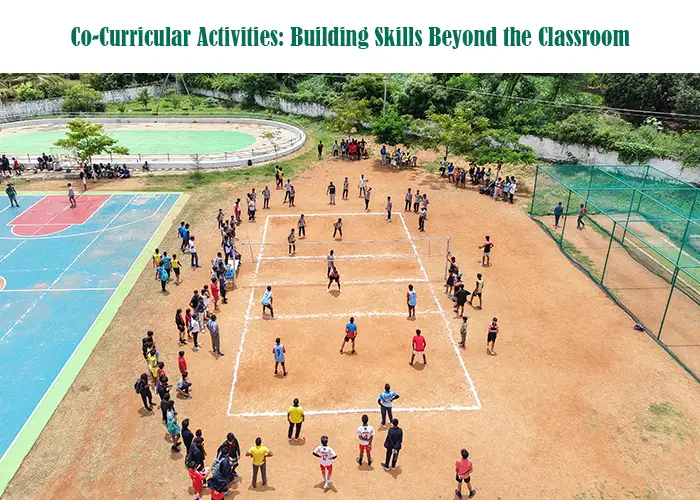
Co-curricular activities, such as sports, debate, and the arts, play a vital role in developing skills that textbooks can’t teach.
Many parents and teachers wonder: Are co-curricular activities a distraction from studies, or do they contribute to them? The answer lies in finding a healthy balance that supports overall student development and academic success.
If students pick the right selections and manage them accordingly, co-curricular activities can improve learning, grow life skills, and prepare students for a life beyond examinations.
Are co-curricular activities beneficial?
Yes, co-curricular activities have real benefits for students. The experience of understanding how to put a theory into practice helps students engage with academic ideas in real scenarios. A debate club develops students’ communication and reasoning abilities while playing on a team, and teaches relationship-building and resilience.
Sports and athletics, and cultural and literary activities, contribute differently. Physical activities build the body and mind, and literary and cultural pursuits develop creativity and emotional intelligence.
Combined, these both make for a balanced learning environment that develops academic development but also personal development.
A research paper, “Effects of Co-Curricular Activities on Students’ Academic Performance,” found a positive correlation between students’ participation in co-curricular activities and success in their academic performance.
So, co-curriculars are not just “fun extras”; they actually work to develop the whole student.
In addition, in the area of arts and sports, a study from China found that students who did both types of extracurricular activities had significantly higher scores for collaboration, emotional regulation, open-mindedness, and performance on tasks than those who did not participate in either type of activity.
Why are co-curricular activities important for students?
Early confidence & cultural awareness
From early years, participation in music, drama, art, or cultural events supports students in identity exploration, self-expression, and valuing diversity.
The students’ confidence will be developed to perform in public, celebrate cultural traditions, and be accepting of differences in others.
Physical & mental health
Typically, co-curricular activities include sports, dance, a yoga class, or an outdoor club. These kinds of activities are obviously beneficial to your physical well-being, help relieve stress, and improve your mood.
Research shows that youth had lower anxiety and depression while engaged in an extracurricular program.
Life skills for the real world
These are the most significant takeaways: leadership, problem-solving, adaptability, teamwork, time management, creativity, and organizational skills. When students manage their schedules, run events, or lead teams, they are practicing skills that hold value in future careers and life experiences.
In other words, co-curricular activities help students grow from mere learners to confident, well-rounded individuals.
Features of good co-curricular activities
Interactive & engaging
The best activities will be hands-on and interactive, such as debates, quizzes, drama, group work, sports, etc.
They create situations where the student acts rather than watches. This will keep the interest level high and the depth of learning deep.
Support health & well-being
Successful programs have opportunities for physical activity (sports, dance, outdoor games) and wellness (yoga, meditation, art therapy). These help students grow mentally as well as physically.
Skill-oriented by design
Programs should aim to build skills such as organizational skills (planning, scheduling), teamwork, flexibility/adaptability, critical thinking, and communication.
For example, a student council project or planning a cultural fest requires delegation, coordination, and time estimation, all of which are pushing your brain to work in real time and the real world.
Advantages and disadvantages of co-curricular activities
Advantages
Improved academic outcome:
Multiple studies show that students who participate in co-curricular programs usually earn better marks.
The logic: co-curriculars teach planning, self-discipline, and concentration, which are also key components of academic work.
Improved life skills & organizational skills:
Organizing events, multi-tasking, and leading teams all foster skills that extend beyond just knowledge content.
Cultural respect & awareness of diversity:
Literary arts, cultural clubs, and events in foreign languages introduce students to new traditions and promote compassion and a global outlook.
Confidence & communication:
Public speaking, drama, debates, and literary performance all require students to engage in activities that push them beyond their comfort zones, fostering improved self-esteem.
Community building & outreach:
Community Service activities teach students social responsibility and empathy while connecting the classroom to actual social needs and realities in their community.
Social & emotional growth:
As the Chinese study indicates, the simple combination of arts and sports leads to increased collaboration, emotional regulation, and open-mindedness, even more than participating in one or the other separately.
Greater perceived satisfaction:
A survey reported that 91% of students who spent 6-10 hours a week in extracurriculars were “very or somewhat satisfied,” compared to just 42% of students who did none.
Disadvantages
Over-commitment / academic neglect:
- Issue: Students might get overwhelmed, and their grades drop.
- Solution: Reduce the number of activities, set proper caps on hours (weekly), focus on one or two high-quality activities instead, and observe if academics are impacted.
Burnout or physical injury (in sports):
- Issue: Too many hours of practice lead to fatigue, injuries, and burnout.
- Solution: Build in rest days, have proper training, supervision, cross-training (not just one sport), and medical visits.
Inequality in access:
- Issue: There are no strong programs at all schools or in all neighborhoods, and disadvantaged students may have a lack of opportunities.
- Solution: Schools and districts should use their budgets to train teachers and partner with local NGOs or community centers to support these programs in underserved areas.
Pressure & stress:
- Issue: Students may feel they are pressured into too many “resume-building” activities to “look good”.
- Solution: Encourage students to follow their passion as opposed to resume building. They can always stop or change their mind, which is important to communicate to both parents and mentors.
Poorly designed programs:
- Problem: Programs that serve only the purpose of entertainment have little educational value.
- Solution: Programs should have clear focus areas (skill development, wellness, teamwork), regularly evaluated and reviewed, establishing feedback loops.
Co-curricular activities vs. Extracurricular activities
Schools frequently associate co-curricular activities with the school’s curriculum (for example, after-school clubs, athletics teams, and school periodicals) and may serve as an extension of the work accomplished in the classroom.
Extracurricular activities often take a more voluntary and independent form, such as private lessons in music, or outside of school “hobby” classes, or clubs in the community that do not directly relate to the curriculum.
Schools like DPS Warangal include literary competitions, sports meets, cultural festivals, and community outreach in their academic calendar, ensuring that co-curriculars are woven into everyday learning. This approach helps students apply classroom concepts in real-life situations, making education more engaging and meaningful.
Education systems across the world have progressively placed more focus on such integration over time.
How safe and balanced are co-curricular activities for students?
- Making sure students will not spend more hours in activities than in their studies
- Sufficient once blind or shadow read supervision by a qualified teacher/coach
- Regular checks for health, rest, and nutrition
- Selecting open channels for students to convey if they feel overextended or are dropping a club
- Schools can provide time management workshops that train the students to manage academics, rest, or activity.
Co-curricular activities can be both safe and rewarding if they are structured intentionally, with proper supervision, clear goals, and a focus on student development.
How to choose the right co-curricular activities for your child
Align with interests & goals
Allow the student to choose based on their passion, sports, drama, debate, art, community service, etc. Interest will sustain effort.
Ensure academic balance
Choose one or two core activities at first and ensure academic performance is sustainable. If grades begin to slip or if the activity load is apparent in school and learning, pause or lessen the activity load.
Pursue guidance from school and community
Connect with teachers, coaches, or community leaders who know both the characteristics of the student and what programs would suit the child within their areas of strength and growth.
Key takeaways
Co-curricular activities are not distractions. Instead, they are also important for growing the whole child. When combined with study, co-curricular activities promote physical and mental health, life skills, organization, confidence, and cultural knowledge.
There are legitimate challenges (overcommitment, inequity, and stress), but with good foresight and support, the benefits outrank the negatives. Co-curriculars help any student become a future-ready person, whether at DPS Warangal or elsewhere, on their journey towards becoming a whole.