
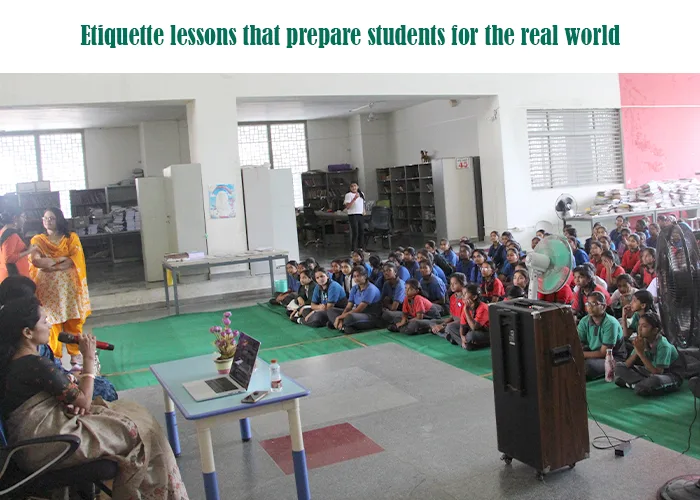
Real success is as much about grades as it is about how you connect with others. This is where etiquette manners come in—they’re the foundation of strong people skills. By offering etiquette lessons for students, DPS Warangal builds in them the confidence to shine in any situation – social or personal.
Leading schools like DPS Warangal get this completely. For us the importance of etiquette is a core part of their curriculum. True etiquette education benefits make well-rounded students who first shine in the classroom, then also shine outside.
Core elements of etiquette education in schools
Effective etiquette education is not a single subject but a pervasive philosophy that influences every aspect of school life. The goal is to instill good manners at school that become second nature for students, preparing them for a world of increasingly complex interactions. Below are some of the ways how schools teach etiquette as part of holistic development.
1. Communication skills
This is the bedrock of all social interactions. Students are taught how to express their ideas clearly and respectfully. More importantly, they learn the value of active listening.Truly hearing and understanding what others say which is a skill that reduces misunderstandings and builds stronger relationships. In-class discussions and respectful debates on various topics form part of etiquette lessons for students, reinforcing the importance of etiquette in every interaction.
2. Promoting empathy and inclusivity
How schools teach etiquette is by putting emphasis on empathy. By encouraging students to see situations in different views and be respectful about all cultures and backgrounds, students should be pure. A child should be inclusive and make everyone feel belonged. This is their magic. Teachers teach good manners at school, parents teach manners at home, together they grow the nicest teenagers and later adults.
3. Building confidence and leadership
Etiquette education builds a student. When they feel confident in social situations, their self-esteem is at the highest. A huge benefit of this training is becoming a sensible leader who cares for all, be strong and assertive without carrying the mean image. They also learn to be kind without being weak, and to be respectful no matter what. They become amazing and strong personalities when they know how to hold their own stand.
4. Digital etiquette
Today, good manners are not limited for physical interaction, they also apply behind the screen. Etiquette lessons cover students on how to act online. They learn to be polite in emails, on social media, and in online chats. Tell a student that their online actions leave a digital footmark, so they have to be as cautious as they would be when hanging out with someone in person.
How DPS Warangal teaches etiquette
DPS Warangal has a proactive approach to instilling etiquette manners, ensuring that these lessons are not just taught but lived. How schools teach etiquette here is a blend of curriculum, mentorship, and practical application.
- Integrated curriculum:
Etiquette is a subject that shapes your young child and their character. Instead of being a separate class, it’s blended into lessons on values and building good character. This makes the importance of etiquette easier to understand. Students learn good table manners, polite conversations , and interact respectfully with others. - Role modeling:
At DPS Warangal, teachers and staff are as well behaved as we want our students to be. Because students learn from what they see, we make sure they see only kindness and empathy. From greetings to conflict resolution, their behavior shows a child how to behave in day to day life in situations. Students see and incorporate them in their regular interactions. - Interactive learning:
Role-playing activities allow students to practice real-life social scenarios. Group discussions on introductions, apologies, or table manners reinforce etiquette lessons for students. Assemblies frequently highlight the importance of etiquette, ensuring that these ideas are embedded in school culture. - Leadership opportunities:
Positions like student council or house captains are known to be the responsible kids and are also selected based on their good manners at school. The better the behavior the more so the reason to be selected as a head of student. By leading peers, they experience firsthand the etiquette education benefits of respect, ethical behavior, and collaboration.
Benefits of etiquette education
Etiquettes take students very far, first they boost them as a person – their personality and later in the bigger picture – their academics.
- Enhances interpersonal relationships:
By practicing good manners at school, students make more friends because their positive energy attracts more positive people. The importance of etiquette becomes evident in every interaction. - Prepares students for diverse environments:
Whether with teachers, peers, or future employers, students trained in how schools teach etiquette display confidence and respect. These qualities prepare them for college, careers, and adulthood. - Improves communication skills, confidence, and self-esteem:
When students master polite, respectful behavior, they gain self-assurance. This is one of the most valuable etiquette education benefits, a strong sense of self-worth that empowers leadership, participation, and expression.
Practical etiquette tips for students and parents
For etiquette lessons for students to take root, they must be supported at home. Parents play an equal role in imparting the importance of etiquette in young curious minds of their children.
- Establish a routine of politeness:
Encourage polite greetings and phrases like “please” and “thank you.” These simple things show their good manners at school and at home. - Encourage ownership:
Sit with your child and make charts with them or explain their manners through a game, they will be sure to catch up quicker than any other form of lesson. Parents can help children see the etiquette education benefits by celebrating progress. - Model and reinforce:
Children imitate what they see. By demonstrating respect, parents mirror how schools teach etiquette, making the lessons more effective.
A student needs both knowledge and character, hence the importance of etiquette cannot be skipped. Intellect makes no sense if the student does not show good behavior. Intellect comes later, it is the second layer after. DPS Warangal’s approach to etiquette lessons makes a student who can handle any social setting and make it their own. Respect and kindness should be a person’s second nature. With these skills, students become empathetic leaders tomorrow. Teacher and parent together, at DPS Warangal we reinforce how schools teach etiquette and empower students for a future filled with success.