

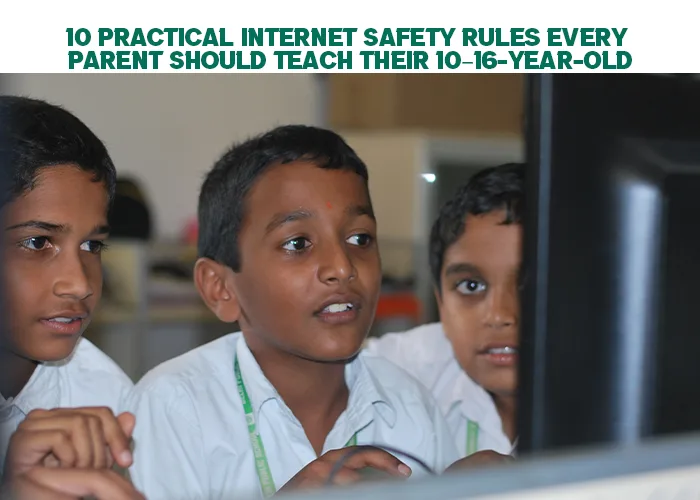
By default, kids born after 2010 have been exposed to a digital world, since their infancy. Right from using it to watch themselves on camera, to communicating with family using video calls, these digital natives view this tech with the same innocent view as their in-person interactions. Children, especially between 10-16 years of age, are often online for chatting, learning and leisure activities. However, this can often confuse parents with thoughts concerning online risks, such as “Where do I start?” or “What rules make sense?” While you don’t want to restrict them, you need to apply a mix of tech interventions, common sense parenting, and digital stranger-danger lessons to help your child make the best of their online access time.
This blog briefly discusses 10 clear, practical and simplified rules to teach internet safety for kids and make optimum utilisation of digital resources. Let us further see how these actionable tips and tricks can work at different places, ensuring digital safety for students.
Why internet safety matters for 10–16 year-olds
Teens have gained more freedom and independence online. From social media to multiplayer games, all are one click away. However, with access comes risks, like cyberbullying, online attacks, and oversharing with strangers. Crossing these boundaries can have damaging repercussions that need careful explanations for kids, and important lessons.
On the other hand, the internet offers benefits for learners to access useful resources and expand their knowledge. Kids can connect with family and peers, supporting their social growth. Creativity flourishes through sharing artistic and creative content. But as a parent, keep a razor sharp eye on whom your child is communicating with and if they’re known to you –for example, don’t avoid asking why they’re chatting with their friend’s father, or mother, even if the conversation seems benign. .
10 practical rules for internet safety
#Rule 1: Keep personal information private – Children should not share any personal information on the web or any social sites. Teach them to refrain from sharing their full name, address, phone number, etc., without any parental guidance. Apart from exposing sensitive identifiable information which can lead to theft, it also makes you vulnerable as a family.
#Rule 2: Use strong passwords and keep them secret – Explain passwords to the children, and why they are necessary. Passwords are like the key to your house, and not meant to be shared with anyone, including friends. Advise them to change their passwords periodically for ultimate protection.
#Rule 3: Think before you post or send – What goes online, stays online. Think before you post or click on any random link. The photos and messages may be copied or seen later for negative and unfavourable purposes. Ideally, parents are advised not to share identifiable information about their kids in real time – for example, avoid posting when you’re on holiday, or allowing your kids to post in real time. With a little bit of sleuthing, even the most basic of scammers can put your digital timeline and footprint together. This makes kids vulnerable targets when it comes to getting information out.
#Rule 4: Only accept friend/connection requests from people you know in real life – Offline safety rules apply to online safety for children, too. Warn teens about ‘stranger danger’ online and the risks of meeting unknown people online. Connect with people you know in real life and be cautious of identity theft by potential predators. Also, teach them about safe connections. Just because they know adults in real life is no reason for them to engage with them 1-1 online, without any good reason. Encourage them to keep you informed about any conversations with grownups. Teach them that people can also hide their identities behind seemingly real accounts.
#Rule 5: Set device & app boundaries (screen time, location – avoid public Wi-Fi for sensitive tasks) – Parents should define when, where, and how devices are used. This can be done by using parental controls to keep a check on your child’s screen time, location and other activities. This also instills awareness about device management in young minds. Most apps now offer a higher level of security and monitoring for kids; apply all of them to keep your kids safe.
#Rule 6: Enable parental controls and privacy settings together – Parental controls are a great way in keeping children safe online. It lets you monitor your child’s online activity, without directly invading their privacy.
#Rule 7: Learn to recognise phishing, scams, and inappropriate links – It is equally essential for parents to learn to recognise potential online scams. With this, you can warn your kids about suspicious activities and links. These unknown attachments may be inappropriate and can invite malware issues. Teach your kids about this too; there are plenty of videos which are age-appropriate that show kids how to handle phishing calls, and social engineering calls which mimic parents, or other known family members.
#Rule 8: Be kind and responsible online – Online safety for teens goes both ways. As a user, one should encourage respectful behaviour towards other users. Refrain from indulging in cyberbullying or online trolling for entertainment purposes. Teach your kids to not not share their or anybody else’s content or texts without their due permission. It may seem innocuous on its own but many kids have faced all forms of bullying with terrifying consequences. Right from screenshots of unsavoury conversations being disclosed, to sharing intimate photos which are not age-appropriate, cyberbullying can take on many forms. Help your kids identify them, and avoid them by showing them the consequences of some of these actions. There are documentaries that can help highlight such issues, with care.
#Rule 9: Talk about what happens online – keep communication open.With teens in particular, parents need to build a communication bridge to communicate with them openly. Encourage them to come to you if something seems odd or upsetting without any fear of judgment. Parents should not only monitor their actions but also show a genuine interest in keeping children safe online. Teens tend to shut down and develop a private world of their own; and that world can be filled with a number of dangers. Help them feel comfortable to confide in you.
#Rule 10: Know that you can seek help – you are not alone – At the end of the day, children should know that they can speak up. They shouldn’t bottle up, in case anything unpleasant happens, like harassment, grooming or bullying. With counselors, parents, and peers, students can talk to anyone without any shame or fear of judgment.
How parents at DPS Warangal contribute to safe online habits
DPS Warangal blends digital safety education into daily school life. This is accomplished through several habits that we adopt to maintain the online safety of children. Our school conducts parent-student workshops about screen-time management and internet safety rules for children. Here, teachers educate students on internet safety and the mindful use of technology.
This parent-student partnership together delivers consistent safety messages to students. We encourage parents to follow DPS Warangal online safety device policies to set clear boundaries for safe usage, both in class and at home. Parents and educators can jointly discuss digital risks and set shared controls and guidelines.
Tips for making these rules work in your home
While it is important to maintain decorum in the learning environment, it is equally crucial to practice these rules at home too. Parents can make a “family internet agreement”. Instead of only acting like a strict monitor of your child’s activities, promote openness and joint device use in the comfort of their home. This reduces the risk of unsafe and secret browsing.
As parents, differentiate between good and bad digital habits for your child to ensure online safety for children. Parents must understand that kids copy what they see and hear. Thus, as a role model, encourage honest talk about your personal experiences or online mistakes. Rather than blaming the teens and their choices, make your child feel safe and heard. As trends change, update and review rules periodically in keeping children safe online.
Conclusion
In a world where children grow up online, there can be no compromises with safety. Internet safety is as important as the usage of digital media. It is the duty of parents and educators to stay aware and involved throughout the learning process to ensure online safety for their children.